
A year later, NearbyGame is live on the Microsoft Store. It is a quiet game where you walk real roads between real cities, through changing weather and ambient audio. No combat, no quests, no timers. This post is not a launch announcement -- it is what I actually learned along the way.
In the previous blog, I wrote about how I pivoted from the original NearbyGame vision -- a venue-finding app -- into the walking game it is today.
Learning #1
Do not force ideas, even when the idea is just for fun and personal passion. If it feels heavy to build, it probably is. Recognize it early and pivot.
Today I want to announce that NearbyGame is officially launched, almost two months after that pivot. In this blog I want to share the other learnings I have gained during this journey.
You can try it here: nearbygame.com (free for Windows, Washington state included).
Why a Walking Game, of All Things
It is always interesting to me that this type of game exists -- walking simulators. I played a few over the years, but they all had fancy graphics, or puzzles to solve, or horror plots. None of them were like what I wanted: no purpose at all, simply just walk.
Completely relaxing and calming. No story, no jump scare, not even 3D rendering. Just ambient noise, like you are walking alone on a trail.
Most of my days are spent in busy work -- driving from A to B, being distracted between housework and office work. I am not sure if I am the only person feeling this, but my time is constantly not controlled by myself. The freedom of doing nothing is a luxury. That is why I do not want another grind with a game. I just want to sit there, listening to white noise, doing nothing, no purpose.
However, I do not have the fancy skill of 3D rendering. I tried, even with the help of AI, and I do not think that can take me too far. So I decided to focus on where -- a sense of place. I decided to walk-sim in the real world.
I picked where I live -- Washington State -- as a starter.
I started building a map of this state, connecting major cities, defining terrain, adding layers of sounds, and placing famous landmarks accordingly.
Learning #2
When building an idea, I still need to recognize my limitations. Most importantly, I need to be the first customer of my own idea.
Building the World
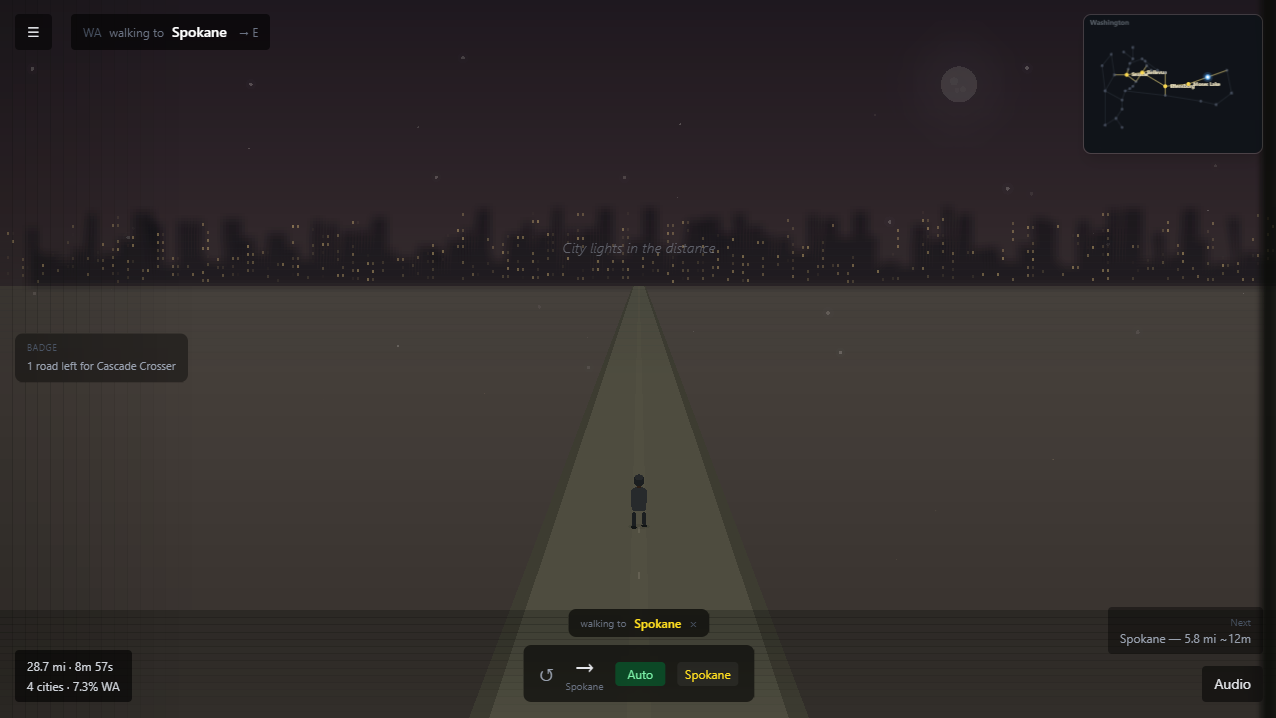
Even though I am not doing fancy 3D rendering, I still want the game to feel like a real place. My approach was to render the environment and change the ambient sounds based on where the player is walking. For example, near a city like Seattle or Spokane, the game shows a city-like view and you hear traffic or distant music. Near a forest or trail, like Olympic National Park, you see green and mountains, and hear frogs and creeks.
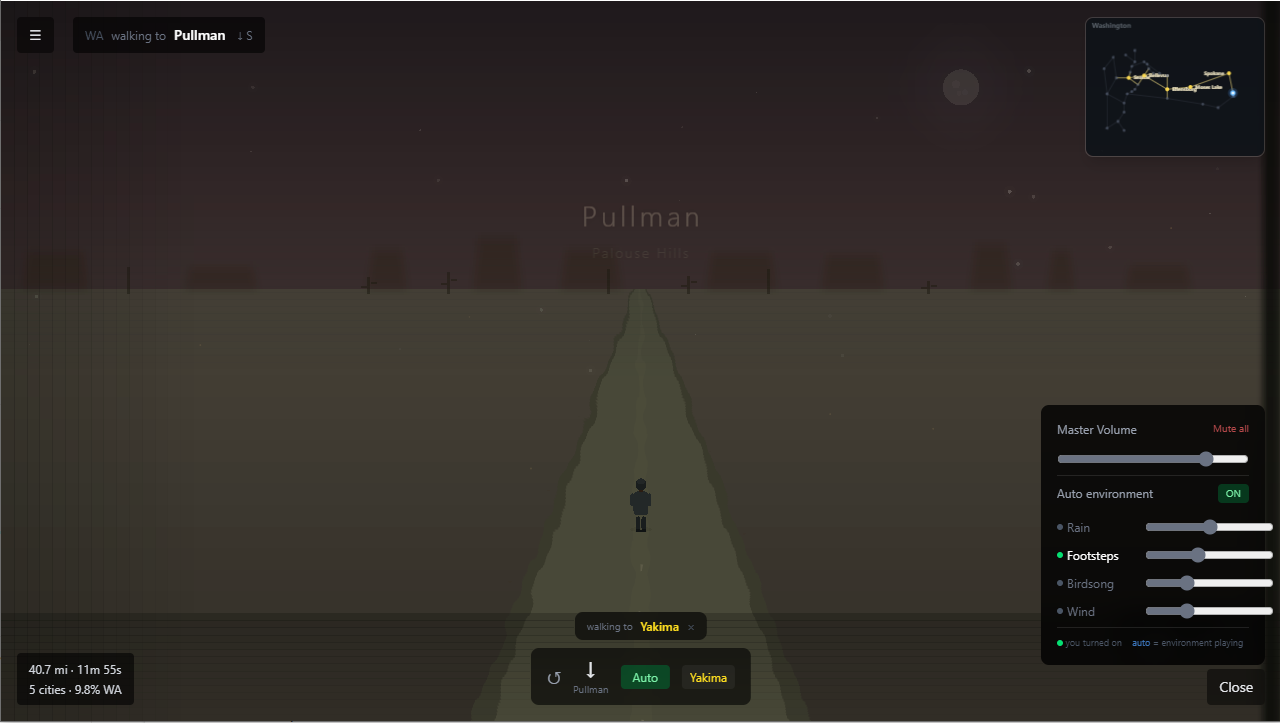
In the screenshot below, you can see the game has an Auto Environment Audio option that automatically adjusts the ambient noise based on your location. It also shows the walk towards Pullman, a city in eastern Washington, where the game depicts a rocky, gravel-like environment.
But walking is not just about cities. I also designed landmarks that players can discover along the way. For each discovered landmark, you can click the link to learn more about it.
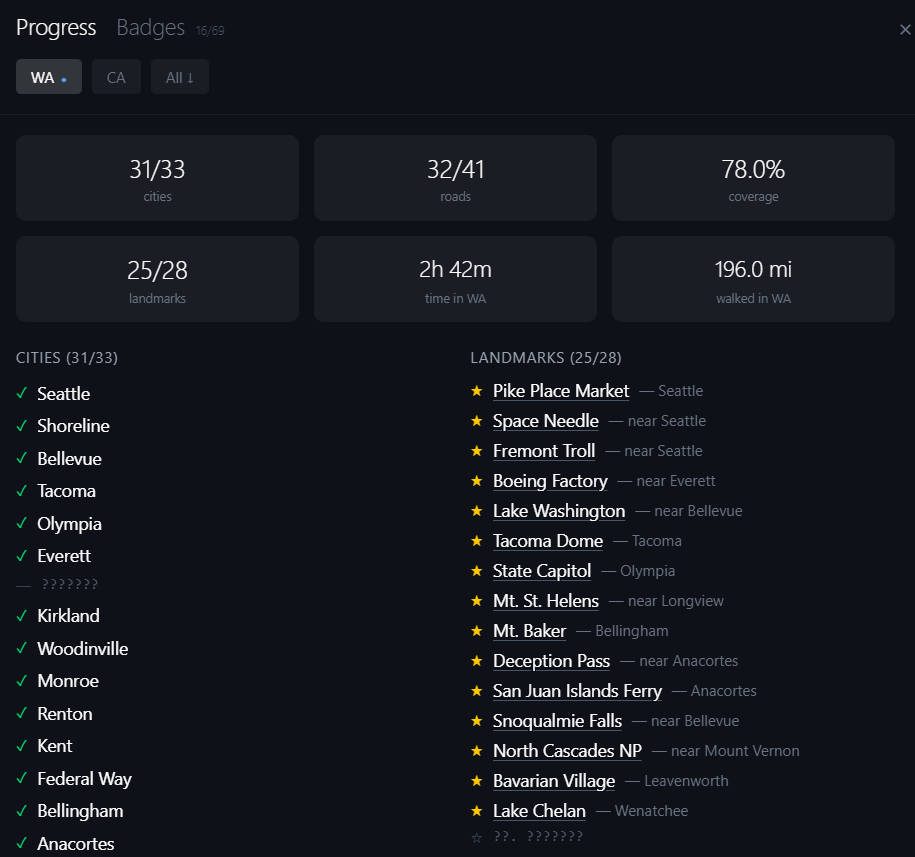
This might actually be the most fun part of creating the game. AI can help to a certain degree when planning landmarks for each city, but a lot of the time it oversimplifies and skips interesting places -- unless I give it specific instructions like "use Instagram to search what places are most shared." I learned a lot during this process myself. For example, I learned that Kurt Cobain's memorial is in Aberdeen, Washington. I learned there is a place called Thor's Well in Oregon. In Idaho, there is a massive pear-shaped boulder called Balanced Rock. So many cool places I had never heard of or been to, and just learning about them was already a great experience.
Learning #3
Even if I do not have what other people have (like fancy rendering), I can still add value and meaning to the idea from a different angle.
The Hard Parts -- Microsoft Store IAP
This is the section I would actually want to read on someone else's blog, because nobody talks about it. So I will be specific.
NearbyGame uses In-App Purchase through the Microsoft Store to unlock additional regions. Conceptually simple. In practice, this was the single hardest part of the entire project, and the painful part was not the SDK itself.
I submitted eleven iterations of the build to Partner Center before IAP worked correctly end-to-end. Each iteration was a full MSIX rebuild and a full submission. Fortunately, Partner Center submissions are now fast enough that I could try again and again without waiting days between attempts. Still, there is no good local sandbox for Store IAP. You can stub purchase calls in dev, but to actually validate that a real purchase against the real Store catalog unlocks the right entitlement on the real machine, you have to ship a real build, exercise the real purchase, refund it, and try again.
The bug that ate the most time was not even in the IAP SDK. It was
a permissions issue with Tauri 2's plugin-fs in an
MSIX context. I was writing the entitlement receipt to local
storage after purchase, and the write looked like it was working
-- no error, no exception, the function returned cleanly -- but
the file simply was not there afterward. The mkdir calls right next to it worked fine, which made it look like a
filesystem layout problem, not a permissions one. Several days of
staring at this later, I found it: fs:allow-write in the Tauri capability config does
not cover binary writeFile(Uint8Array) in MSIX. You
need the more granular fs:allow-write-file permission. Once I added that one line, the entire IAP flow worked
on the next submission.
Learning #4
Give yourself enough room to cross the finish line. Even when I was excited to ship, the last piece turned out to be the most challenging part. Do not underestimate the final stretch.
Where It Is Now
NearbyGame is live on the Microsoft Store. The free tier covers Washington state -- 33 cities and 37 roads. The full version ($4.99, one-time) unlocks Oregon, BC, Idaho, and Nevada, with more regions on the way as DLC.
No account, no email, no microtransactions. If you've ever wanted a game you can sit with for 30 minutes without anything demanding your attention, give it a walk.